h1
h2
h3
insert www.google.com hello
websites are cool!
h1
h2
h3
h4
You don’t need more content. You need less, used smarter.
A content waterfall is a system that helps you get more value out of everything you create. One strong piece becomes many, without starting from scratch every time.
And everybody loves a waterfall (unless you have aquaphobia).
In this guide, I’ll walk you through:
- What a content waterfall system is
- How to create one strong anchor piece of content
- Ways you can adapt that piece into multiple assets

What is a Content Waterfall System?
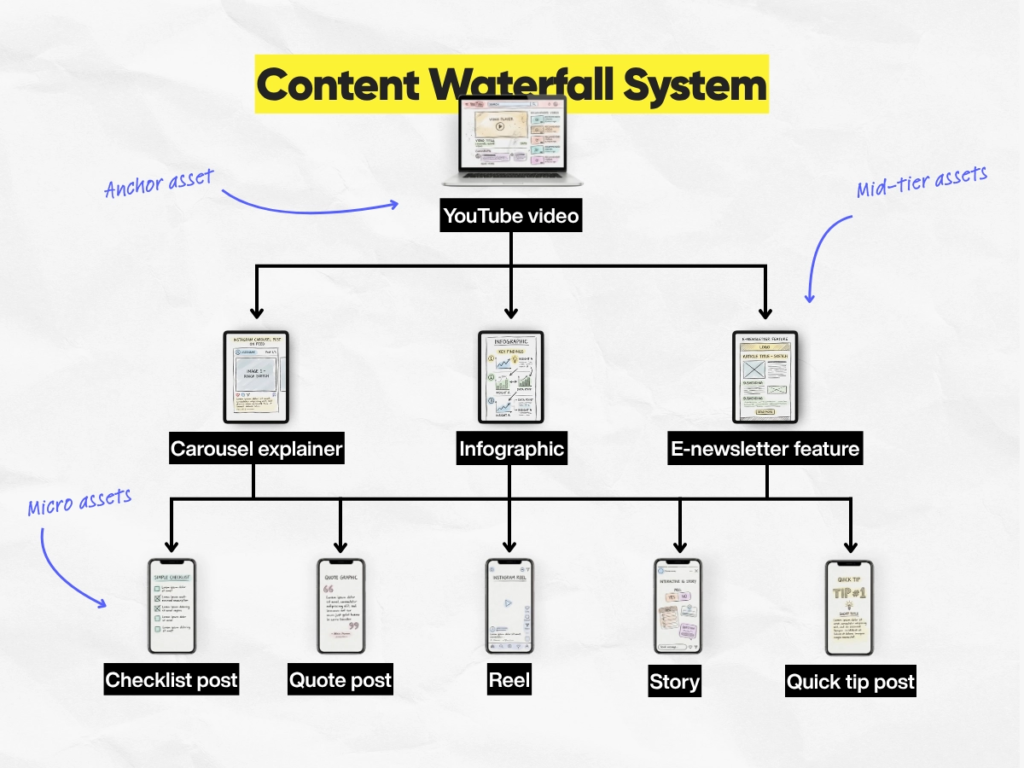
A content waterfall is a high-leverage repurposing system. A structured way to turn one core piece of content into multiple supporting pieces across different formats and platforms.
You start at the top with a high-value, in-depth asset. From there, you repurpose and redistribute that content into smaller pieces. This ensures everything you post has a clear purpose and connects back to a single goal or message.
Think of it like this:
- One long-form video becomes a blog post.
- That blog post becomes several social media posts.
- Those posts can then become short videos, carousels, or email snippets.
One solid anchor piece can fuel an entire month of content. Maybe longer.
The message stays consistent. The format adapts to wherever your audience actually hangs out.
The Three Layers
The waterfall has three layers. Each one has a different job, and together they make sure nothing you create goes to waste.
The Anchor Asset
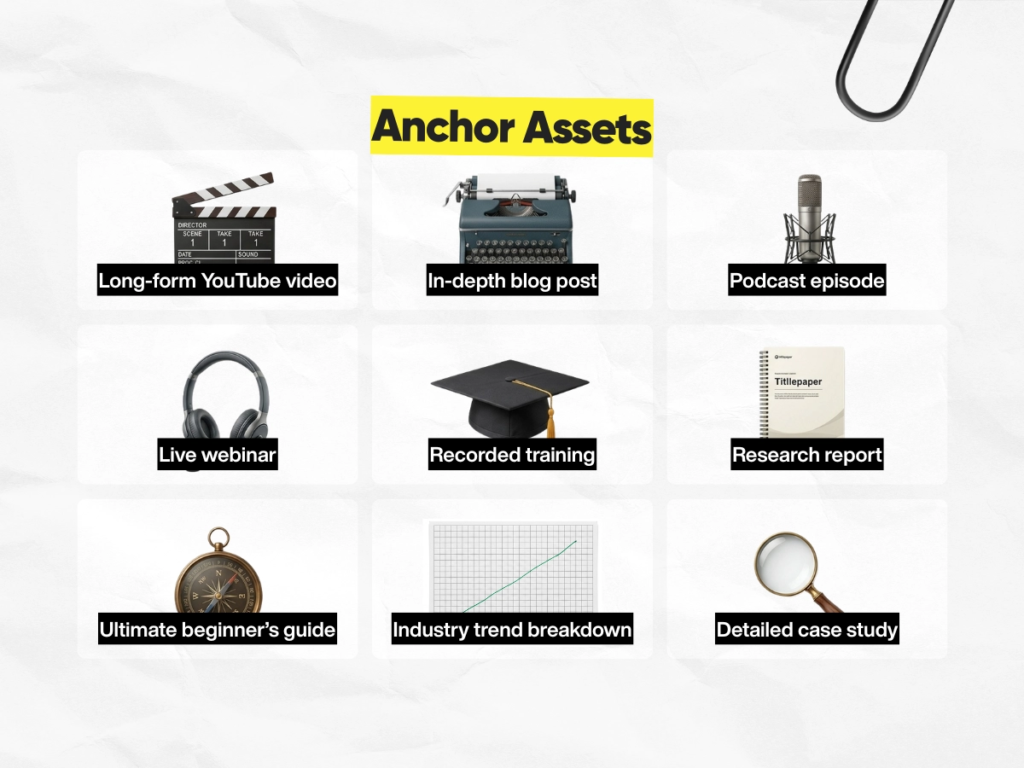
The anchor asset sits at the top of the waterfall. It’s your most detailed, in-depth piece of content.
My golden rule: it must be heavily detailed and genuinely valuable for your audience. If the content is thin, the waterfall will dry up before it hits the bottom.
Examples:
- Long-form YouTube video
- Podcast episode
- Detailed blog post
- Webinar or workshop
- Research report
The anchor asset contains your main ideas, stories, frameworks, examples, and insights. It should solve a real problem or give someone a clear outcome. Always think in terms of value!
Say you create a 30-minute video on building a personal brand from scratch. You cover positioning, content strategy, common mistakes, real examples. That single video can fuel weeks of content downstream, but only because you went deep in the first place.
People can make the mistake of tucking these hero assets away on a website and hoping people find them. The waterfall system changes that by instead of hiding your best work, you use smaller supporting pieces to consistently drive traffic back to the main source.
Mid-Tier Assets
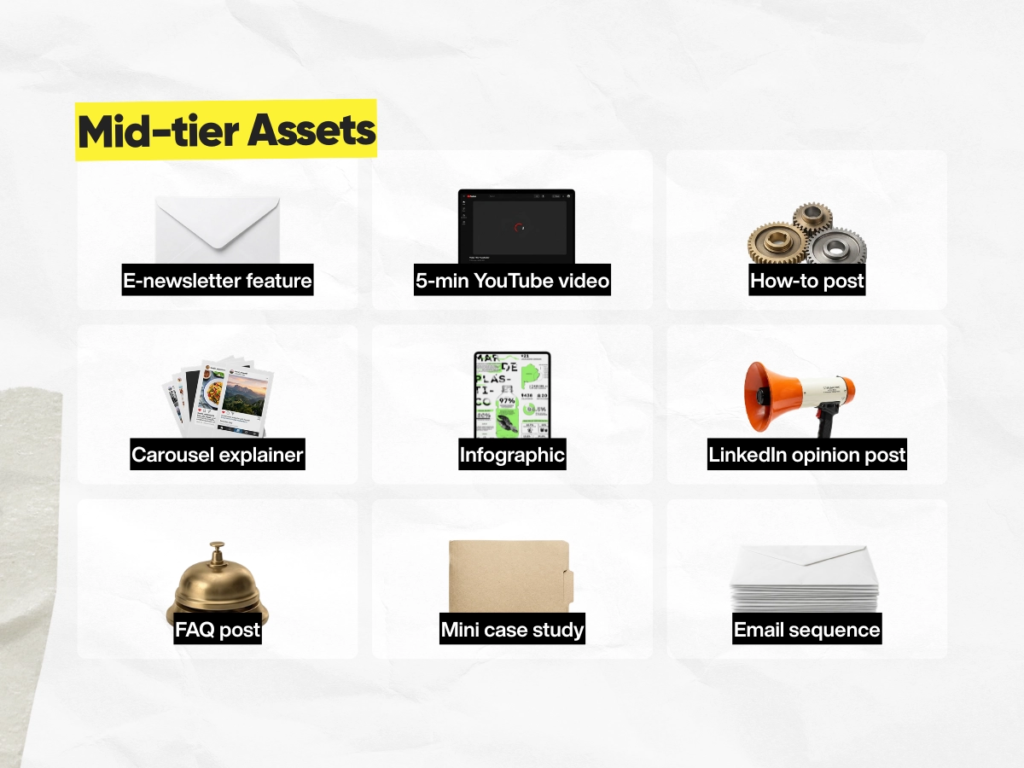
These are structured pieces pulled directly from your anchor. Each one zooms in on a single concept, section, or angle from the original.
Examples:
- Infographic visualising a section from the anchor
- Blog post expanding on one segment of your video
- Email newsletter sharing a key story you told
- Carousel explaining one core idea
- Shorter YouTube video extracted from the main one
This layer is where you meet people where they are. Not everyone will watch a 30-minute video, but they’ll read a 2-minute post. Others prefer email. Others want something they can swipe through. Mid-tier assets give you all of that without creating anything new from scratch.
Micro Assets
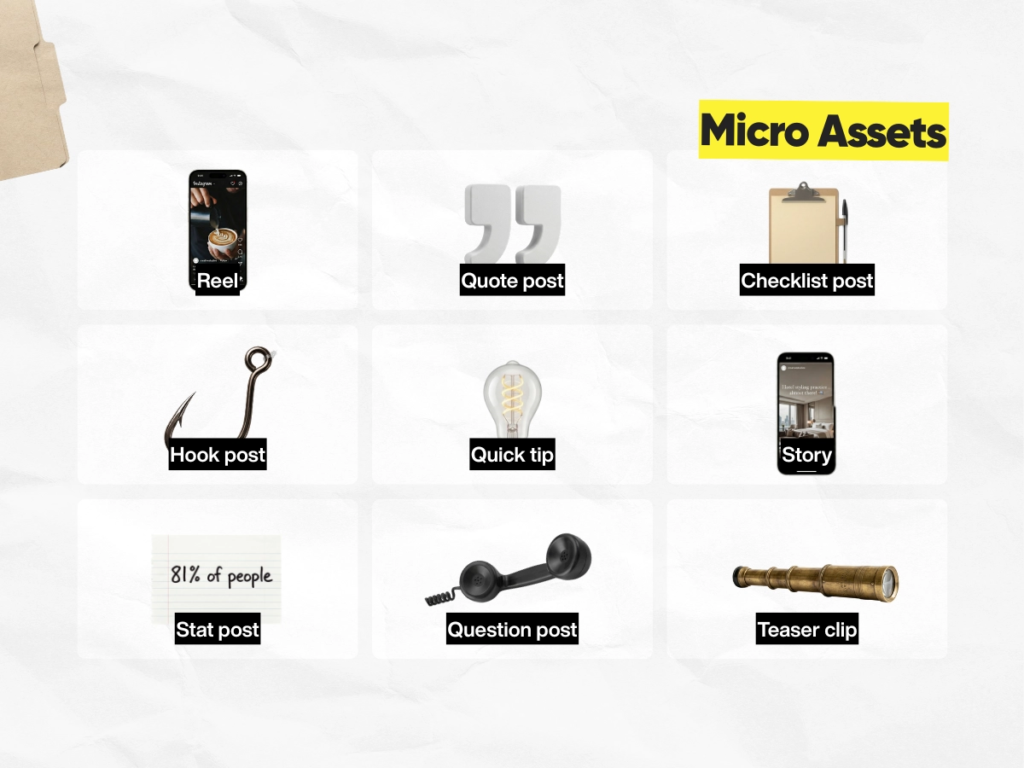
Micro assets sit at the bottom of the waterfall. They’re short, punchy, and designed for attention.
Examples:
- Short clips (Reels, Shorts, TikTok)
- Single quote graphics
- Quick 3-bullet checklists
- One-paragraph insights
- Interactive Instagram story questions pulled from your topic
Micro assets are not random thoughts. They’re extracted highlights from the anchor.
Because they come from a larger framework, they feel connected. Your audience sees the same core ideas reinforced across formats, and that repetition builds authority over time.
Micro content also gets you discovered. A 20-second clip reaches someone new. They resonate with it. They explore your deeper content. That’s the funnel working without you having to chase it.
<aside> 
Tip: Use the anchor asset to build trust, mid-tier assets to deepen understanding, and micro assets to attract attention.
/
</aside>
How to Build a Content Waterfall System Yourself
Here’s a simple way to implement this without a big team.
Step 1: Choose a Core Topic
Pick a topic you have deep knowledge of and that your audience genuinely cares about.
Be specific what exactly the topic is about. Clarity at the start makes everything easier downstream. The more focused the topic, the more cohesive the waterfall.
Step 2: Create the Anchor Asset
This is your source material, and it’s where you really need to use your expertise to create something genuinely valuable.
In a world flooded with AI-generated content, volume is no longer the advantage. Depth is. Anyone can generate surface-level posts in seconds. What stands out now is clarity, lived experience, and real insight.
This is not the place to outsource your brain.
Use AI for support if you want. But the thinking, the perspective, the stories, and the frameworks need to come from you. That’s what builds authority. That’s what algorithms and audiences are rewarding.
Go deep. Explain the problem. Share your framework. Give examples. Tell a story.
<aside>
Tip: Think of this anchor as something worth bookmarking. Ask yourself, if I were my audience, would I want to read and save this for later?
</aside>
Step 3: Audit the Anchor
Once your anchor is finished, it’s time to go back through it and identify every possible part that can be reused across your content waterfall. This is my favourite part, figuring out all the possibilities.
Look for:
- A strong opinion that challenges the status quo. That’s a standalone post.
- Any numbered list or step-by-step process. That’s a carousel.
- A sharp insight. That’s a quote graphic or hook.
- A question you answered clearly. That’s a short-form video topic.
- A story or example. That’s an email newsletter.
By the time you’re done, your anchor should be mapped out with clear opportunities to create mid-tier and micro assets.
For everything you identify, note down the most suitable format and channel it would work best on. Think intentionally. Not every idea belongs everywhere.
Step 4: Create Mid-Tier Assets
This is where depth meets accessibility.
Take the strongest sections you highlighted and turn them into focused, standalone pieces, with each mid-tier asset covering one clear idea.
Add a little more explanation. Clarify the “why” behind it. Include a short example or a quick story if it strengthens the point. The goal is to make the piece valuable on its own, even for someone who never reads the full anchor.
Mid-tier content serves the people who won’t commit to a long-form guide or 30-minute video but still want meaningful insight. It also reinforces your authority by showing that each part of your framework holds up under closer inspection.
Step 5: Extract Micro-Tier Content
The main job of the micro assets are to grab attention.
Take those same highlighted sections from your anchor and strip them down to their core.
They don’t need to explain everything. In fact, they shouldn’t. Their purpose is to spark curiosity and point people back to something deeper, whether that’s your mid-tier content or the original anchor.
Think of them as hooks or teasers for your larger assets. They attract new eyes and gently funnel your audience back to the core piece you created at the beginning.
Step 6: Plan Everything in a Content Calendar
Map everything out so it’s not posted randomly or spaced so far apart that it loses connection. The goal is to create a clear, intentional sequence that consistently drives people back to the core asset, where your real value lives.
For example:
- Release a set of micro-assets as teasers building anticipation for the anchor
- Publish the anchor asset, supported by a few mid-tier pieces across different channels, making it clear that the main resource is now live
- Continue publishing supporting assets gradually over time, so your work isn’t a one-week spike but sustained exposure around the same core topic
This turns your marketing into a cohesive system instead of a collection of random acts of content.
<aside>
Tip: Adapt the content for the platform, don’t repost blindly. Same idea but in a different framing.
</aside>
See the Waterfall in Action
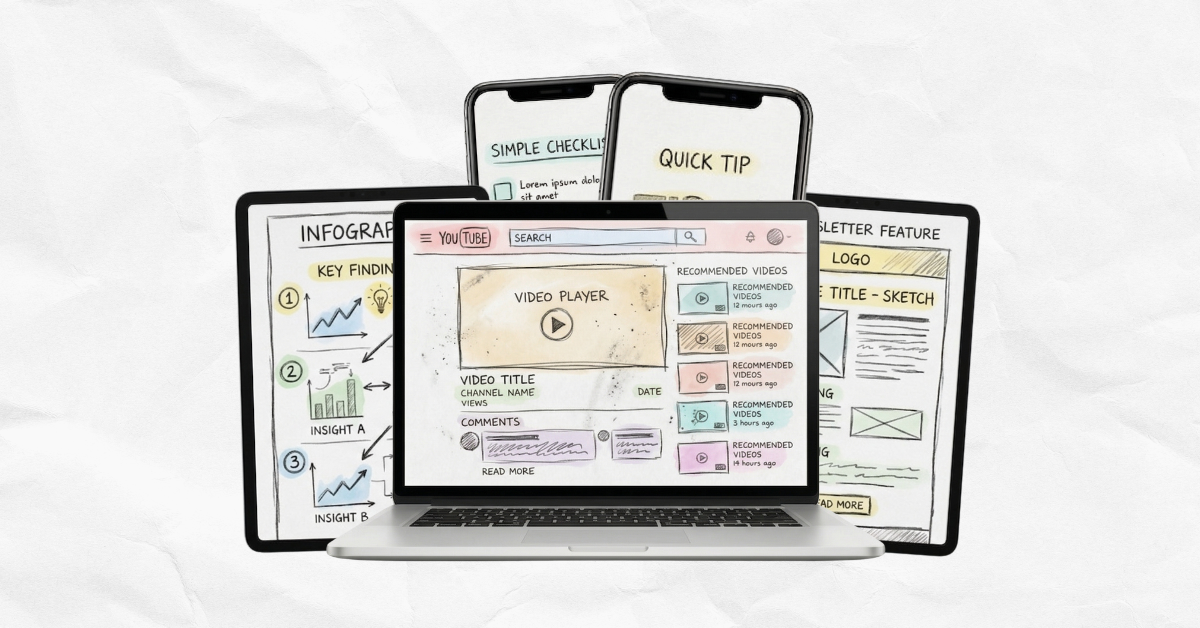
If you’re interested, I’ve created a demonstration showing the waterfall in action using a YouTube video as the anchor.
The Takeaway: One Idea, Many Assets
One strong anchor piece does the work. Mid-tier assets deepen the idea. Micro content pulls new people in. Each layer feeds the next, and nothing goes to waste.
That’s the whole system. And it works because you’re not creating more, you’re just getting more out of what you already made.
Stop creating more. Be awesome and start creating smarter!
<aside> 
Download my free Content Waterfall Playbook to help you create future content using this system.
 Get it here
</aside>